















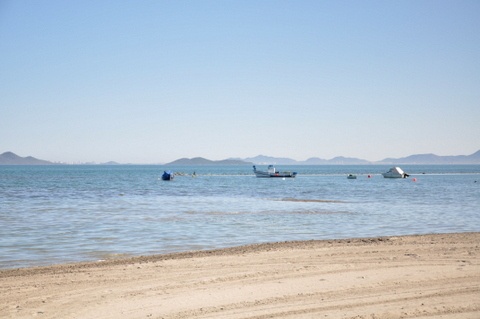









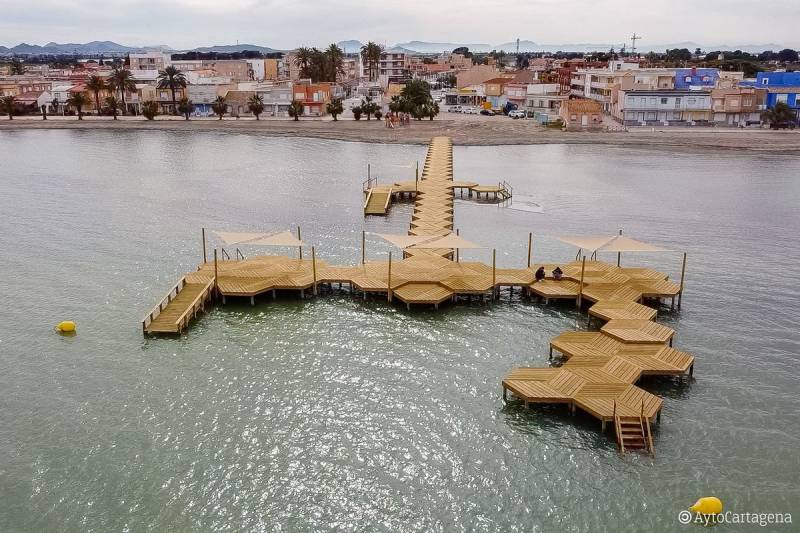
A new pipeline linking the wastewater treatment plants in Torre Pacheco and Los Alcázares could help reduce the amount of treated water reaching the Mar Menor through the Rambla del Albujón. The five-kilometre connection is expected to be awarded in the coming days, with work planned to take around a year to complete. The project has a budget of €3 million, most of which will come from European FEDER funds.
The regional government has taken over the project, which was originally due to be carried out by the Segura Hydrographic Confederation. Once completed, part of the treated water will be diverted into the Campo de Cartagena irrigation system.
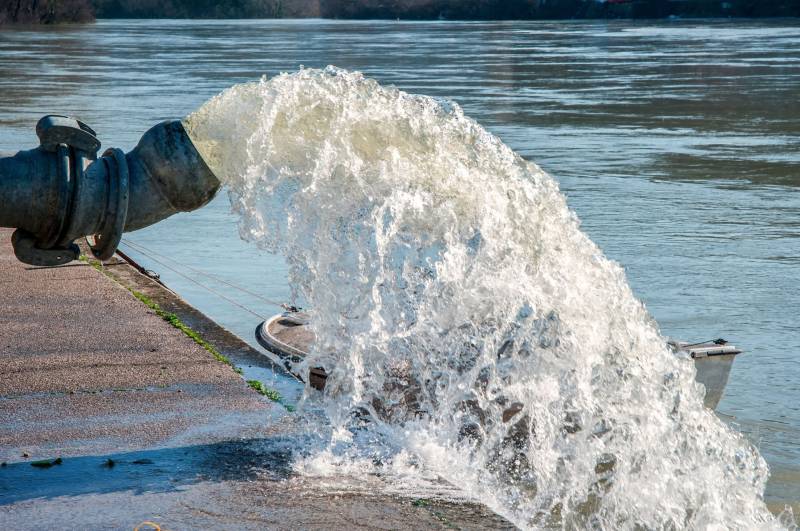 The pipeline is to stop saline water from ending up in the lagoon. The problem is linked to increasingly salty groundwater entering the drainage network around Torre Pacheco. The treatment plant cannot remove the high levels of salt, meaning some of the water eventually reaches the Rambla del Albujón and then the Mar Menor.
The water can be reused for agriculture when it is mixed with water from the Tagus-Segura transfer system and the Torrevieja desalination plant.
According to the regional government, the project is intended to prevent possible discharges of treated wastewater into the Mar Menor. Previous estimates suggest that as much as 80% of the water flowing into the lagoon through the Rambla del Albujón can come from the treatment plant system.
The recent storms have also put the drainage system under considerable pressure. More than 11 cubic hectometres of water reached the Mar Menor during the latest episode, compared with 4.9 cubic hectometres during the previous hydrological year.
The regional Environment Minister, Juan María Vázquez, has again called for action to deal with groundwater beneath the Campo de Cartagena, which continues to contribute water to the lagoon.
Despite the heavy rainfall, the regional government says the Mar Menor has remained relatively stable.
Recent sediment washed into the lagoon has increased turbidity and led to a small rise in chlorophyll levels. Dissolved oxygen has also fallen slightly, but remains within normal levels and is not currently causing concern.
The Mar Menor has also avoided the large temperature peaks seen during some previous summers, although warm nights meant the water stayed relatively warm for longer. The current lebeche wind is also helping by mixing the lagoon's waters and reducing the risk of areas becoming separated from the oxygen-rich surface water.
Meanwhile, work is also moving forward on a new Mar Menor conservation and species recovery centre at the former San Javier airport. The facility will have 21 marine tanks and seven laboratories dedicated to research and the protection of species including the nacra, seahorse and fartet.
Images: Archive